
Role
UX Researcher • Interaction Designer
Team
NCAD IxD
Government of Ireland (DPENDR)
Year
2025
Status
Concept only
Jump straight to
↓ The final result
Overview
Design opens up new avenues for the government to meet the needs of its people. In March 2025, I had the chance to tackle a public-sector design brief from the Department of Public Expenditure, NDP Delivery and Reform, the scale, nuances, and impact of which were unlike anything I had ever experienced before:
How might we bring policy to the public, and engage the public in policymaking?
The solution was just as out of the ordinary—or rather, out of the box. We built a policy vending machine, and used it as a tool for designerly research. This is research through design, in full swing.
How I helped
- Primary user research to uncover hidden insights, opportunities and gaps
- Problem-framing and developing conceptual model
- Product concept ideation, from service blueprint to content strategy
- Prototyping interactions, field testing, packaging and delivery
Setting the scene
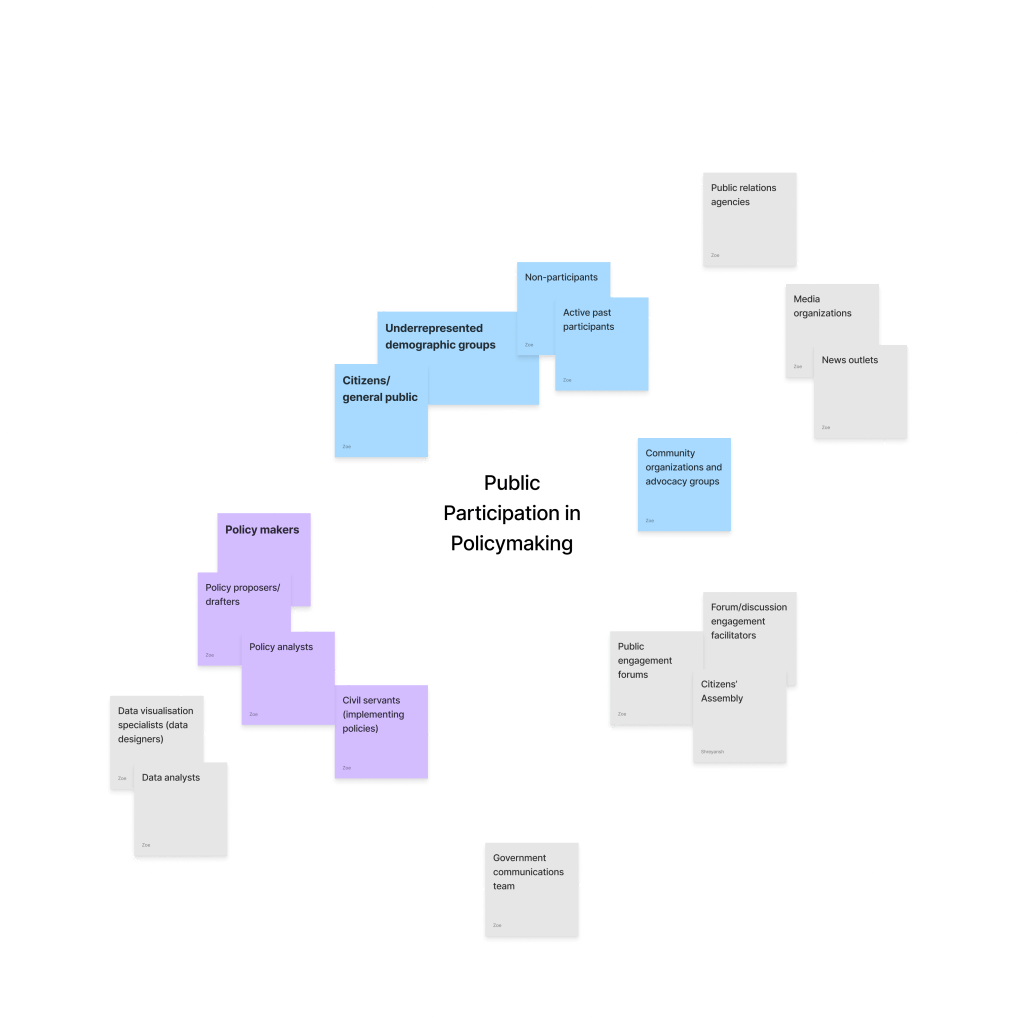
Preliminary research shows that policy is a complex sphere with a complex network of stakeholders, who are not always speaking the same language. This key bit of insight surfaced quite early on in the process, when we realised that no one on either the research side or the participant side had a clear idea of what policy actually is.
In the context of Ireland:
40% of young people in Ireland are not interested in politics.
35% believe national policy would be changed per public opinion.
20% believe innovative ideas would be adopted.
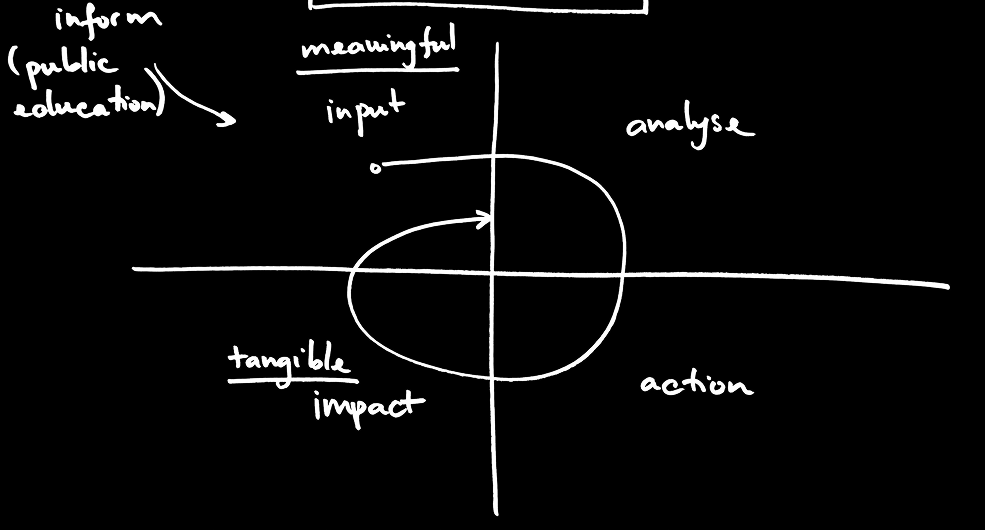
There exists a gap between policy and the public, and closing this gap requires closing the feedback loop that underlies interactions between the two. In order to close the loop, there needs to be meaningful input and tangible impact. If the input is not meaningful, there will be no impact created. If the impact is not tangible, there will not be enough buy in for more input. The inform stage (public education) precedes input to ensure the public are forming informed choices and opinions.
Uncovering hidden Insights
Through primary research—a combination of citizen interviews, expert interviews with civil servants, public survey, and service safari—we uncovered nuances not yet apparent in regular discourse.
Some insights we found:
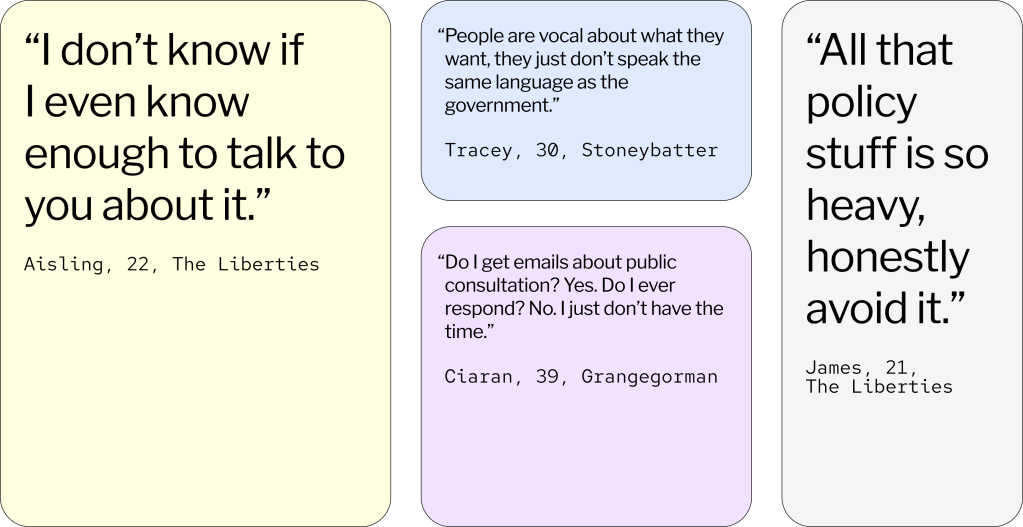
1. People are reluctant to talk, either out of anxiety, anger, or ambivalence.
When they do decide to talk, the discourse tends to be emotionally charged and biased due to extreme emotions.
Challenge: How might we de-stigmatise the topic of policymaking and get the conversation going?
2. Policy is perceived as abstract and detached from real life.
Policymakers are perceived to be interested only in big talks and not real-life matters. The inaccessibility of policy as a subject of discussion makes members of the public feel excluded and ostracised.
Challenge: How might we demystify policymaking and connect it to real-life stories and lived experience?
3. People are overloaded with too much information, but not enough relevant information.
Information (including information overload and lack of relevant, accessible information) is cited as a key barrier to participation. Within the feedback loop, information and public education is a crucial enabler for the public to provide meaningful input.
Challenge: How might we translate policy jargons into simple terms and speak the language they speak?

Defining the Design challenge
Taking into consideration emerging insights and angles, the overarching design challenge was reframed into:
How might we de-stigmatise and de-mystify policy in the public eye?
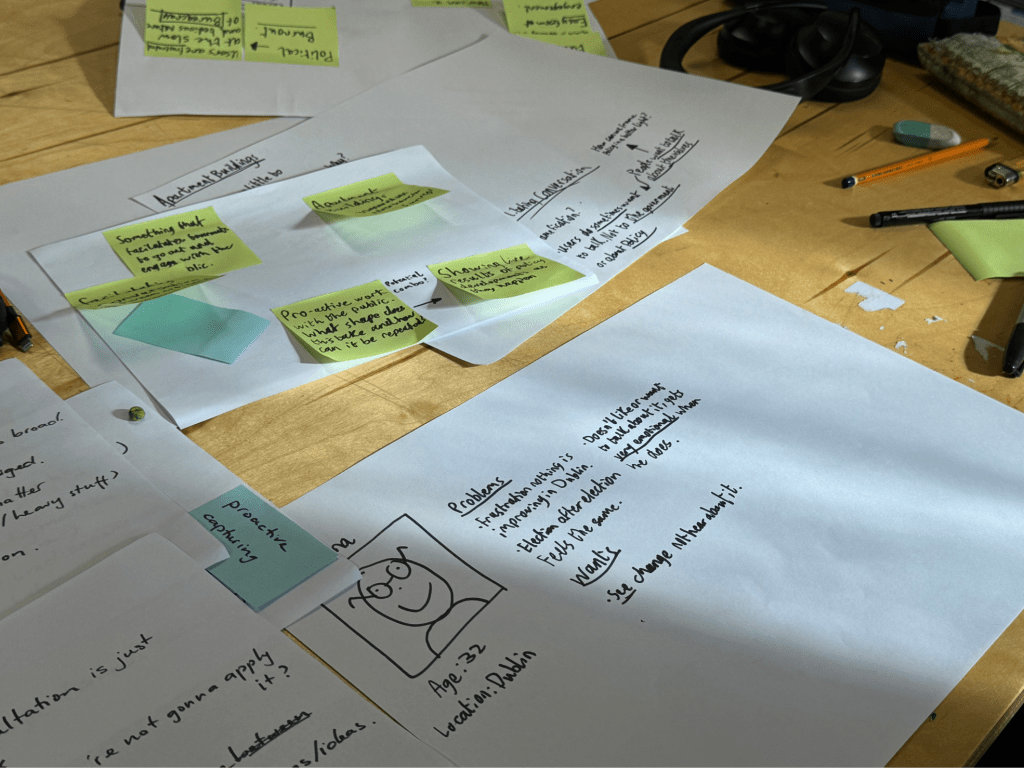
In the policy sphere, people who are active are already being vocal. But for people who don’t speak up—why? With this question, we identified 2 prominent citizen personas: the anxious, uninformed young person and the frustrated, disappointed advocate, along with 1 civil servant persona for an insider’s perspective.
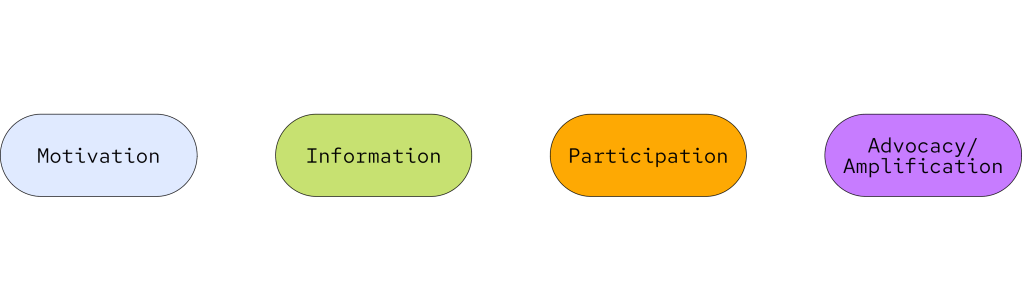
The next question is: When? We cannot change the system overnight. By breaking down their journeys, we have a better chance of targeting the right solutions for the right people, in the right place, at the right time.

Ideation and conceptualisation
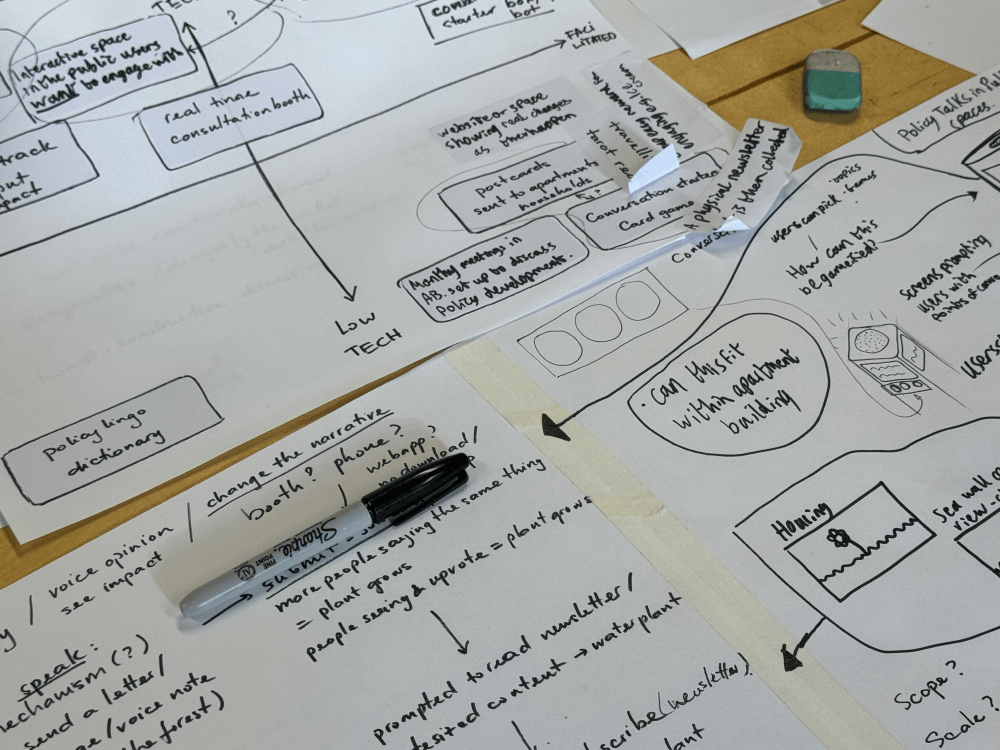
Through rapid prototyping and iterative testing, various interactive concepts were explored, before we arrived at the Policy Vending Machine.

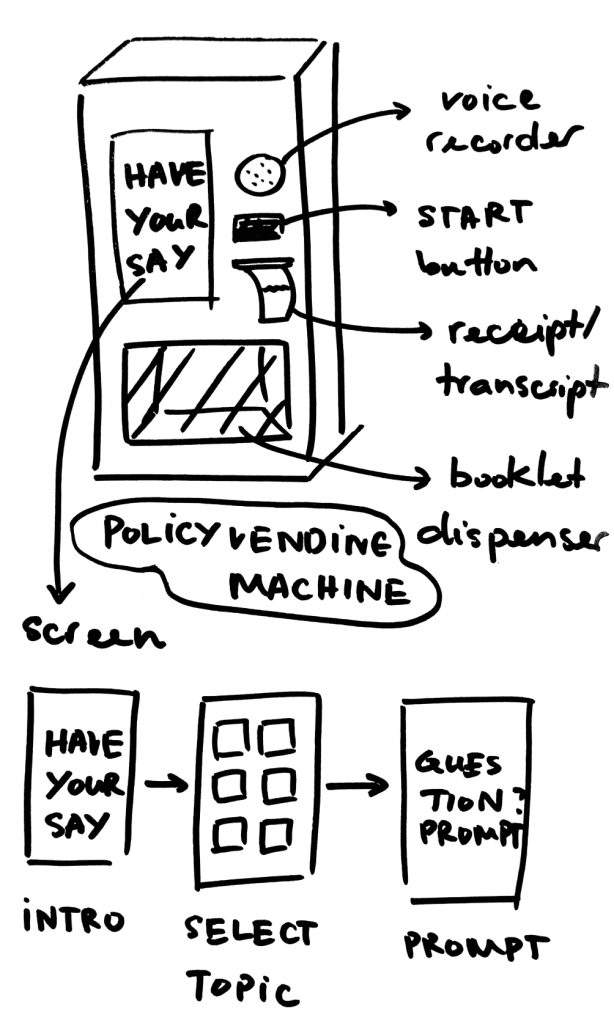
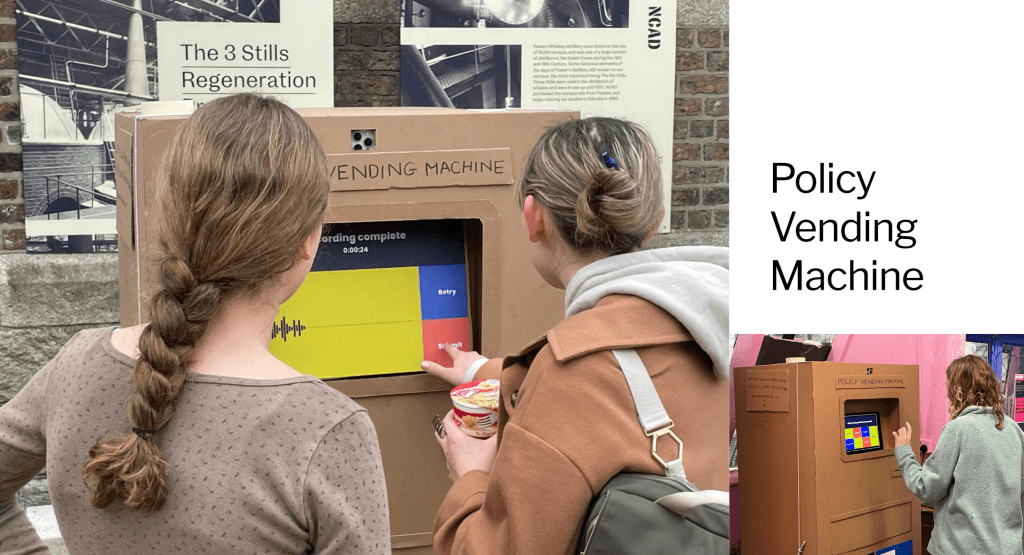
The Policy Vending Machine is an interactive public installation designed to democratise participation in policy development across Ireland. By transforming abstract policy discussions into accessible, everyday conversations, this installation aims to collect diverse public perspectives while simultaneously educating citizens about the policy development process.
The intervention targets the first stage of the policy development cycle (Issue Identification) by building public awareness and facilitating conversation. Rooted in principles of behavioural design, it works to bridge the gap between the state and its people not by inviting people to come to the state, but by bringing state issues down to earth and meeting people where they are.
- Meeting people where they are: Placing interactive installations in public spaces rather than expecting citizens to seek out participation
- Lowering the barrier to entry: Using a familiar, non-threatening “vending machine” metaphor that invites casual interaction
- Exchanging value: Offering tangible takeaways (printed receipt, informational materials) in exchange for contributions
- Creating bite-sized engagement: Offering tangible takeaways (printed receipt, informational materials) in exchange for contributions
- Bringing policy down to earth: Connecting individual to policy implications to invite knowledge-seeking on relevant policy as a starting point
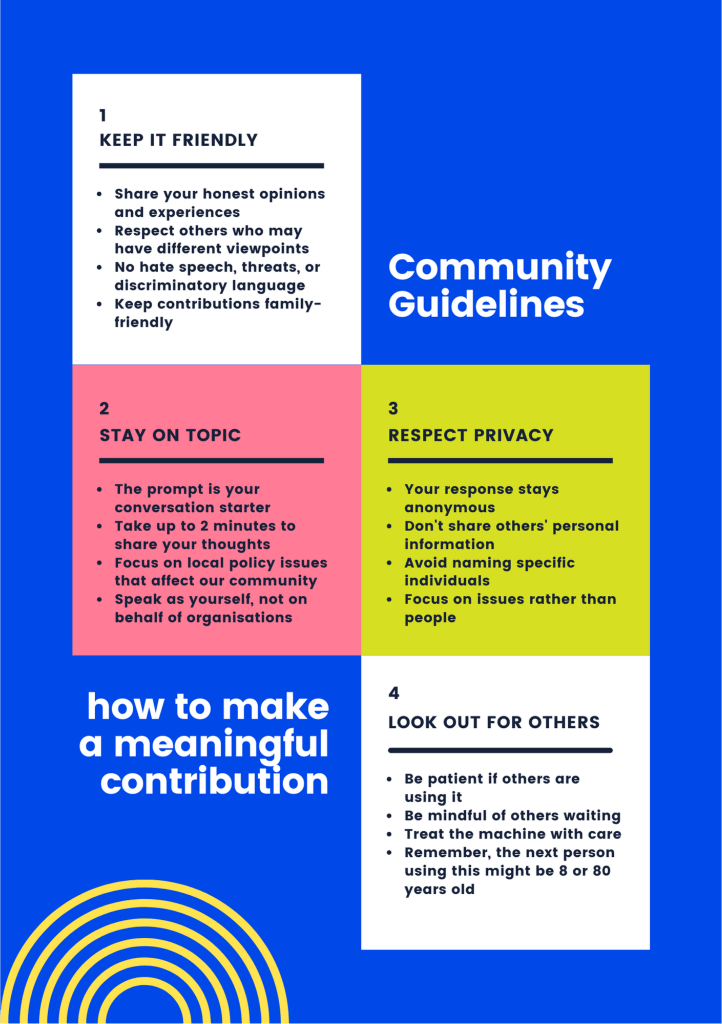
Following this direction, a content strategy and a set of tailored content guidelines were developed to ensure the message would transfer across.

The final result
The Policy Vending Machine installation combines digital engagement with tangible takeaways, creating a novel approach to civic participation that meets people where they are—both physically and conceptually.
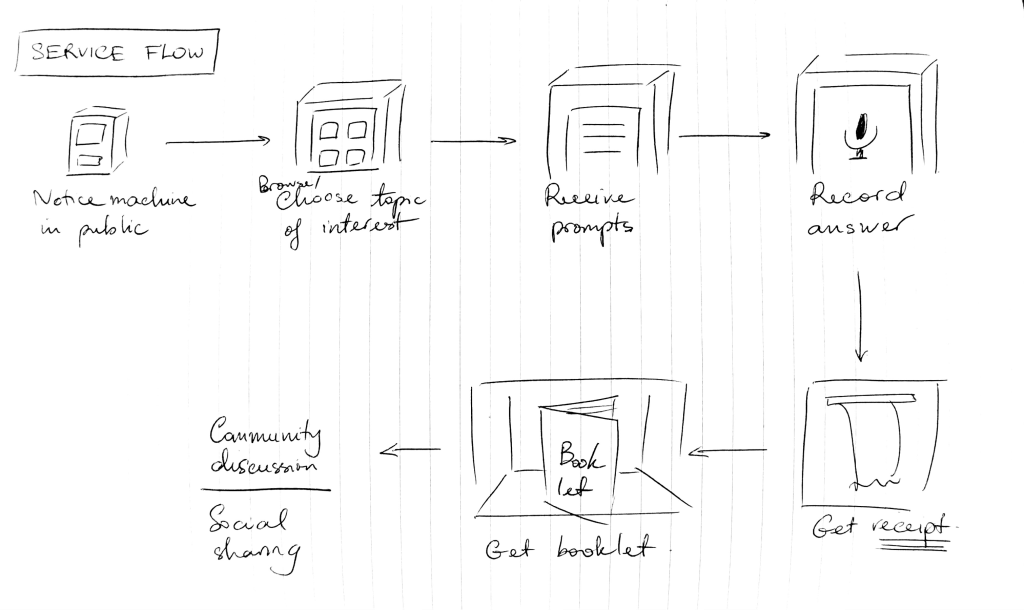
The set of service evidence for our key interaction moment includes a mix of physical and digital artefacts.

1. Public installation
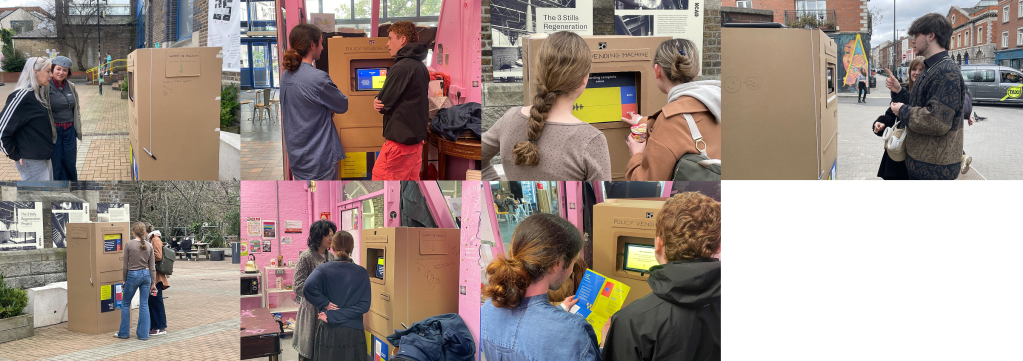
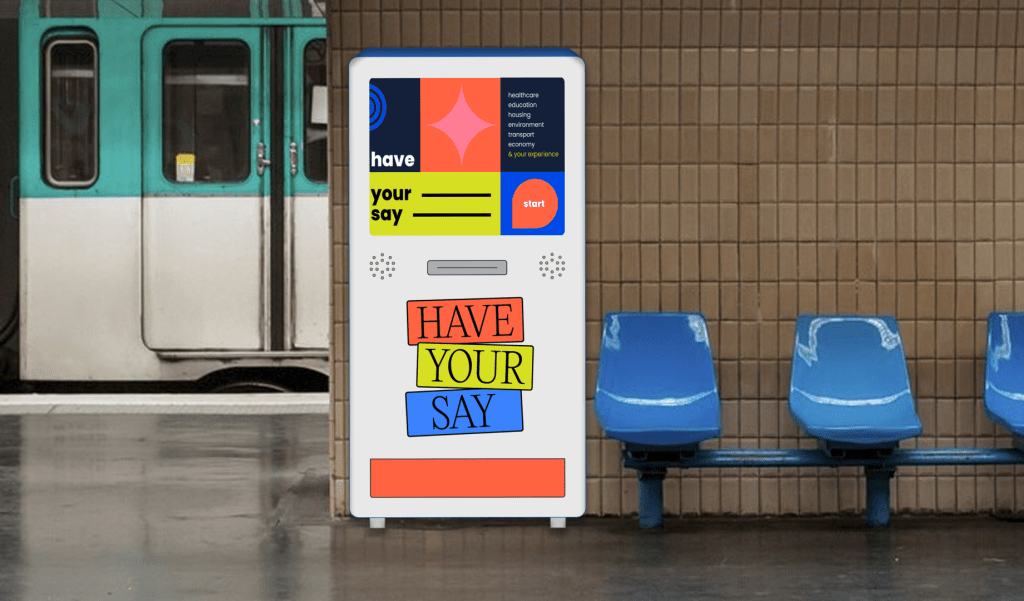
For the purpose of this research, the public installation of the policy vending machine was deployed as a cardboard prototype, with functionalities and mechanism delivered through the Wizard-of-Oz method. Users can interact with a mounted-on digital display, and the operator inside the box will dispense corresponding materials following the interaction.
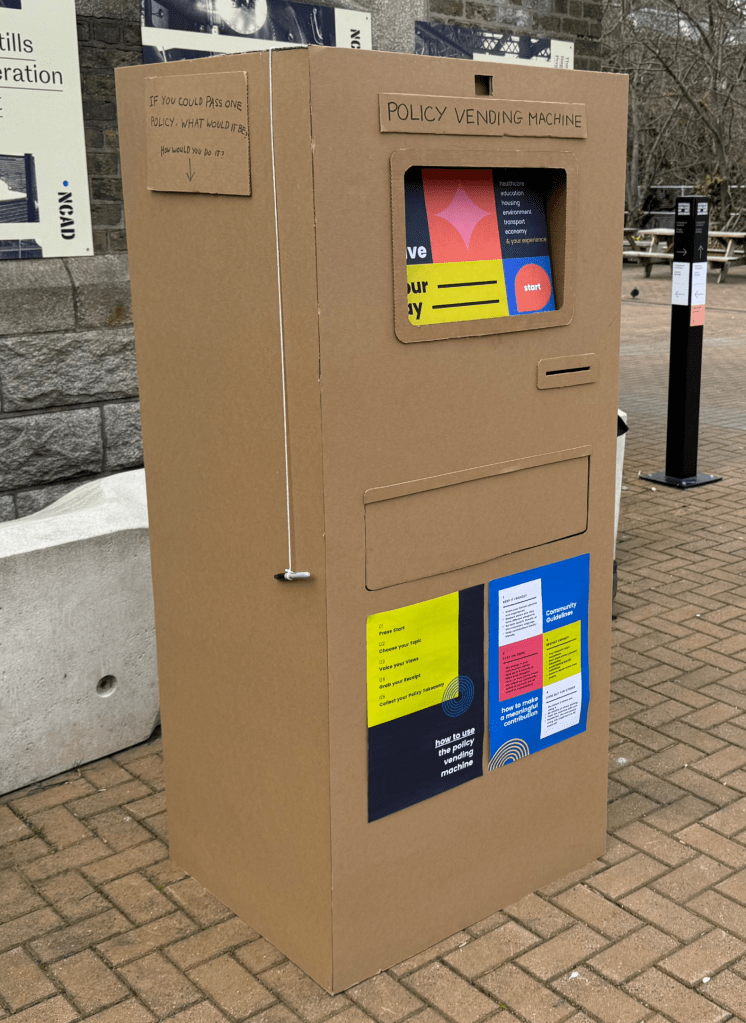
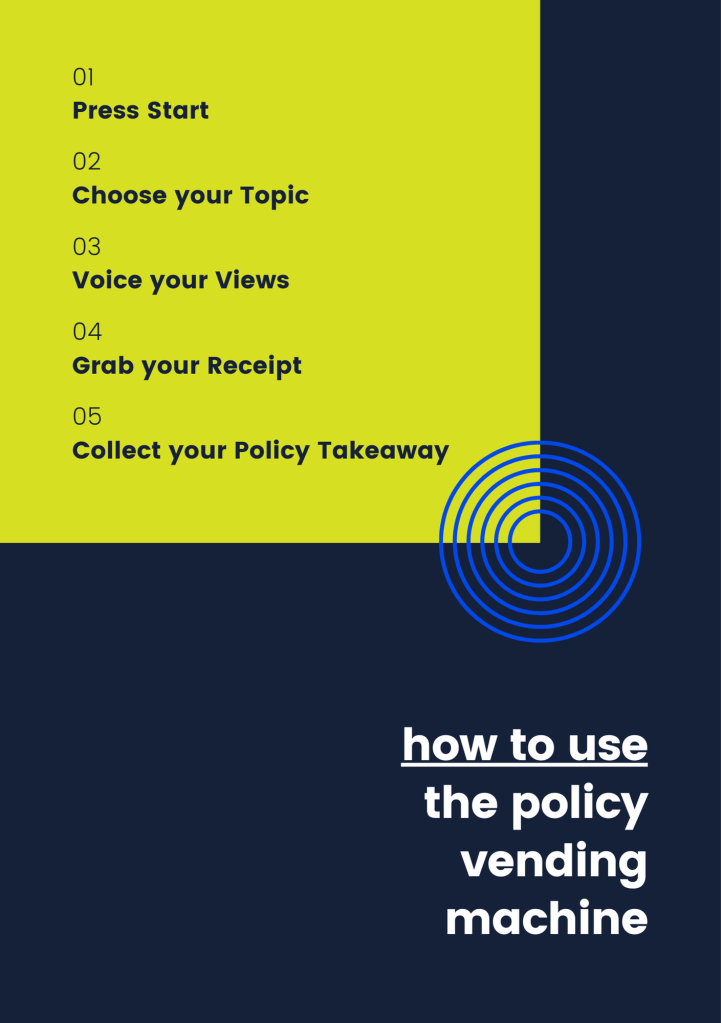
Location strategy, which is both high-coverage and context-targeted, plays a key role in this intervention. The installation is to be placed in high-traffic areas, such as public parks, libraries, post office, shopping malls, train stations. With this foundation, issue-specific questions can then be deployed in relevant spaces. (For example: Education initiatives to be situated near colleges, or healthcare initiatives to be places in hospitals.)
2. Digital interaction
The main user flow is as simple as choosing a topic, receiving a prompt, recording an answer, and complete. Final steps were added in to encourage connection back to the topic of policy, and leverage the endowment effect to instil a sense of ownership of takeaway items.

Following content guidelines and specific policy issues, a variety of prompts would be crafted to:
- Use everyday language and scenarios
- Focus on lived experiences rather than abstract concepts
- Connect personal observations to broader policy implications
3. Tangible takeaways
Tangible takeaways complete the full reciprocal interaction through a combination of education and instant validation. At the end of the session, citizens are given a choice between specific information on their chosen policy area, or a general policy cheatsheet.

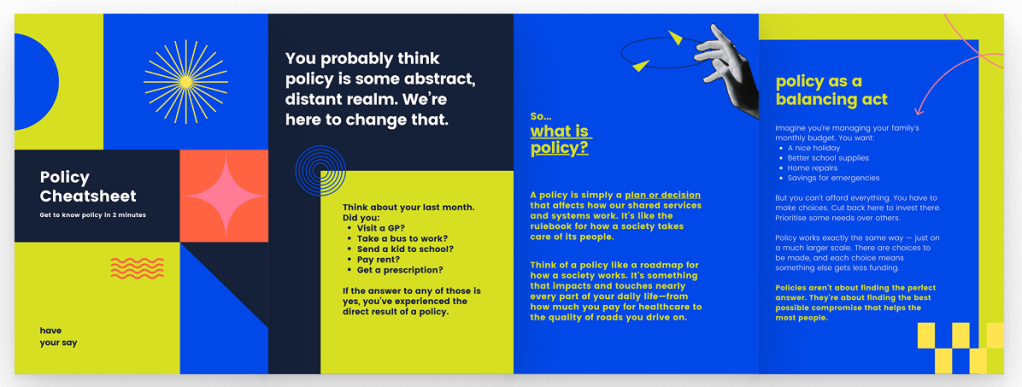
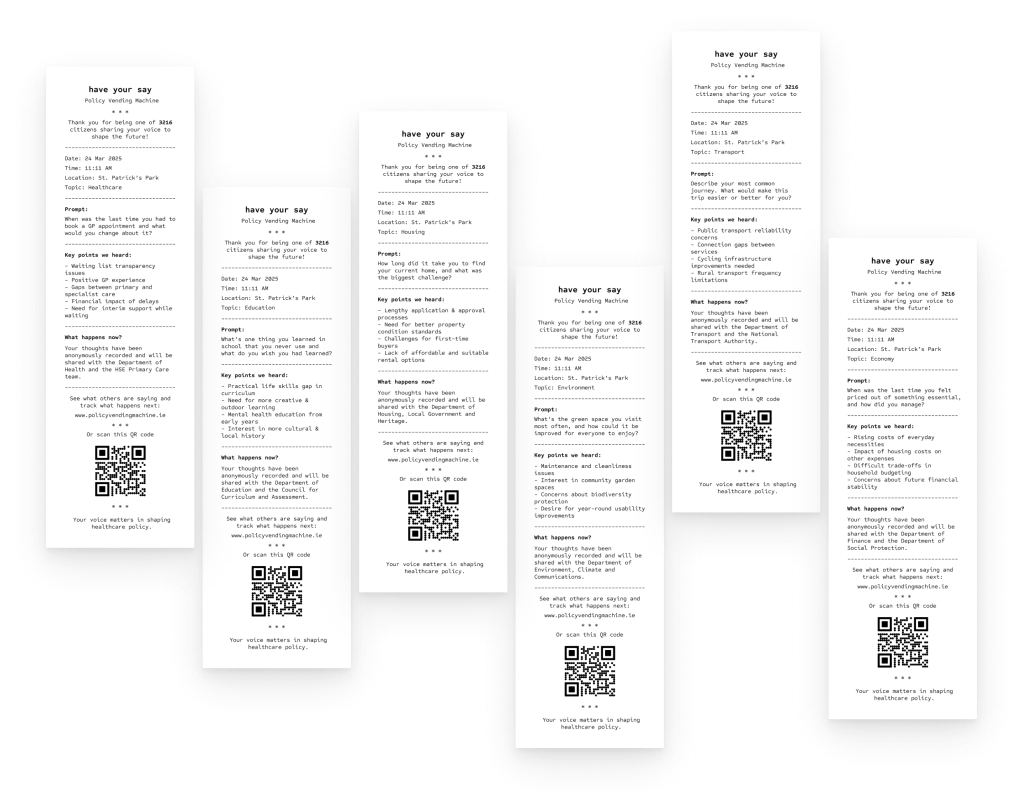
The machine also dispenses a contribution receipt, which acts as a token of immediate acknowledgement, providing reassurance that their contribution has been recorded. These receipts are personalised to their specific time, location, topic and answer. Together, the receipt and booklet create a sense of ownership, with potential for social sharing and repeat entries.
learnings and impact
The Policy Vending Machine tackles the dual challenges of policy engagement: people find policy discussions both emotionally heavy and conceptually abstract. It functions as both a design intervention and a research tool to probe and engage the public, embodying the practice of Research through Design.
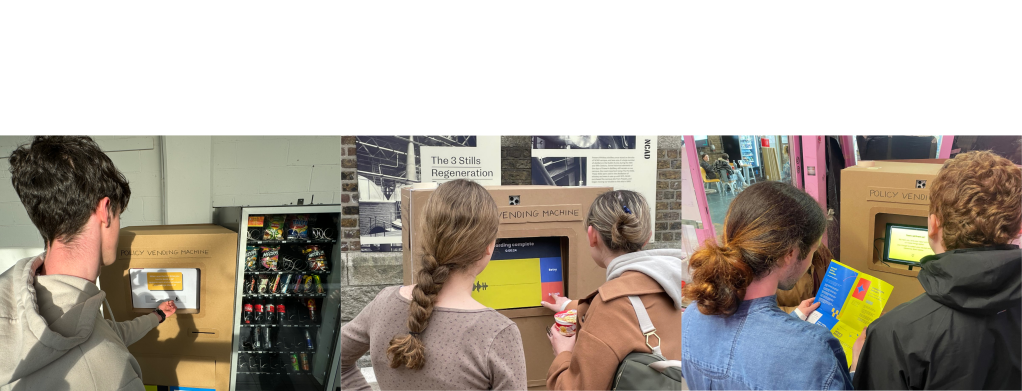
Here are the key learnings we discovered in the process, which I would say are just as important as the aforementioned artefacts—if not more—when it comes to design outcome:
1. Conversation starter
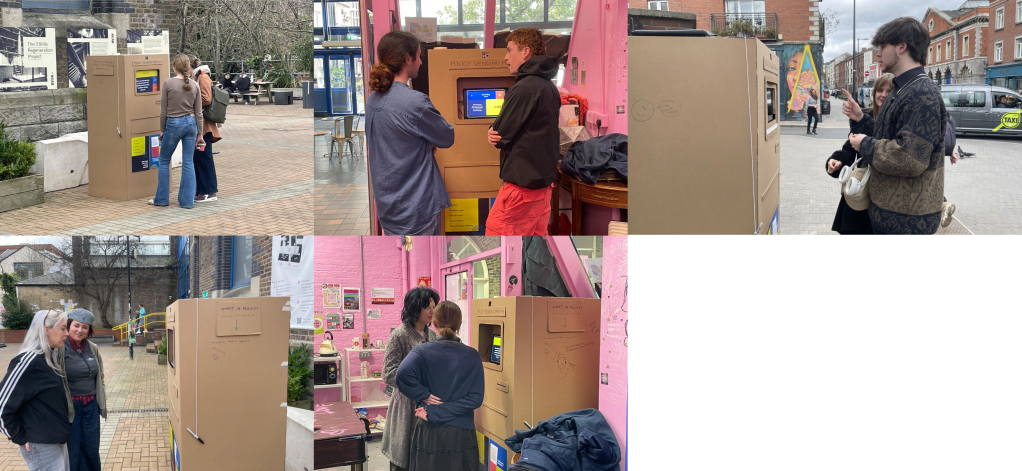
Even though the prototype was designed with individual users in mind, people are more likely to approach in pairs or groups, which naturally creates a dialogue and conversation when prompts are provided. Users then act as facilitators, questioning and encouraging each other to discuss.
2. Public attraction
People are drawn in through sheer curiosity and intrigue at the sight. Once attracted, they are also likely to engage more freely, as the idea of a vending machine conveys a sense of harmlessness. Seeing others engage with it also creates traction to further attract passersby.
3. Incentives work
Getting the receipt and booklet is often a moment of unexpected delight. People immediately express a sense of acknowledgement and ownership, illustrating the impact of the Endowment Effect. People often ask to keep the receipt and booklet afterwards.
4. Social sharing
Both the physical prototype and takeaway materials create interest. Passersby stop to take photos of the machine and people interacting with it, and participants often ask if they could take a photo of their receipt and booklet to share on social media, proving the potential for social amplification.
5. Repeat visits
Participants have come back and asked to do it again, whether to voice their opinions on another topic or to get a different receipt and booklet for takeaway. This proves that behavioural design works to encourage continuous engagement.
In conclusion
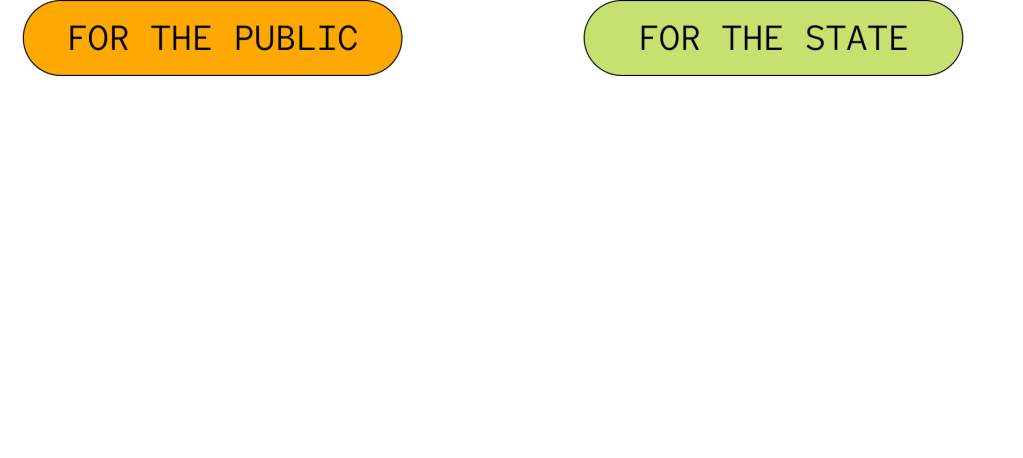
Overall, initial results from field testing have reaffirmed key value propositions we set for the Policy Vending Machine. For the public, it is an accessible channel to voice their views and feel acknowledged. For the state, it is a scalable, visible research tool to quickly gauge public opinion. We are bridging the goverment-citizen gap and the policy-experience gap by meeting people where they are, in everyday life situations, one conversation at a time.
It’s not every day that one gets to design for better public services and civic engagement, and to see design being that bridge between policy and the public, between the state and its people. As a citizen and a designer, this gives me hope.
 Zoe Tran