

Or how the basic principle of writing applies to design evangelization.
If it’s not just wording — then what is it?
I have put on many writing hats in the span of my career as a writer. Just within my current job, I’ve had at least 5: translator, sub-editor, word-filler, copywriter, and UX writer / content designer. I present them here in a neat, sequential order, but in reality, they do overlap, even as my career maturity has grown tremendously compared to where I started. I still get notes from designers on Figma asking me to “translate this” or “fill in the wording for this”.
And if you’re like me, at some point you’ll just get a bit sick of telling people that it’s not just wording that we do. But if it’s not just wording — then what is it?

This is where you work your magic as a writer. As writers, we’ve always been taught that the first and foremost principle of good writing is: show, don’t tell. For those unfamiliar, “show, don’t tell” essentially means demonstrating what happens, rather than simply describing the scene. Take anger for example — instead of describing that I was angry (or fuming, or furious), you could say I stomped down the stairs, kicked the chair to one side and slammed my fist on the table, causing your mom’s favorite flower vase to fall over and smash into pieces. By showing instead of telling, you get your audience immediately transported into the midst of the action, as opposed to letting them passively observe from afar. You get them hooked, you get their buy-in.
Knowing this, how might we then show people what we do, instead of just telling them?
(Because let’s be honest, that clearly hasn’t got us very far.)
The Assessment Scale
A while ago I made an attempt to answer this question, possibly the most important “How might we” of my career. Previously, our design planning process when it comes to UX writing only covered one single dimension: whether a task required UX writing work or not. The column for UX writing in our planning sheet was marked with either a yes or a no. It was reductive at best, and failed to capture the layers, nuances, and complexities we were working with day by day. And we, bogged down by the sheer load of our work, simply let it happen.
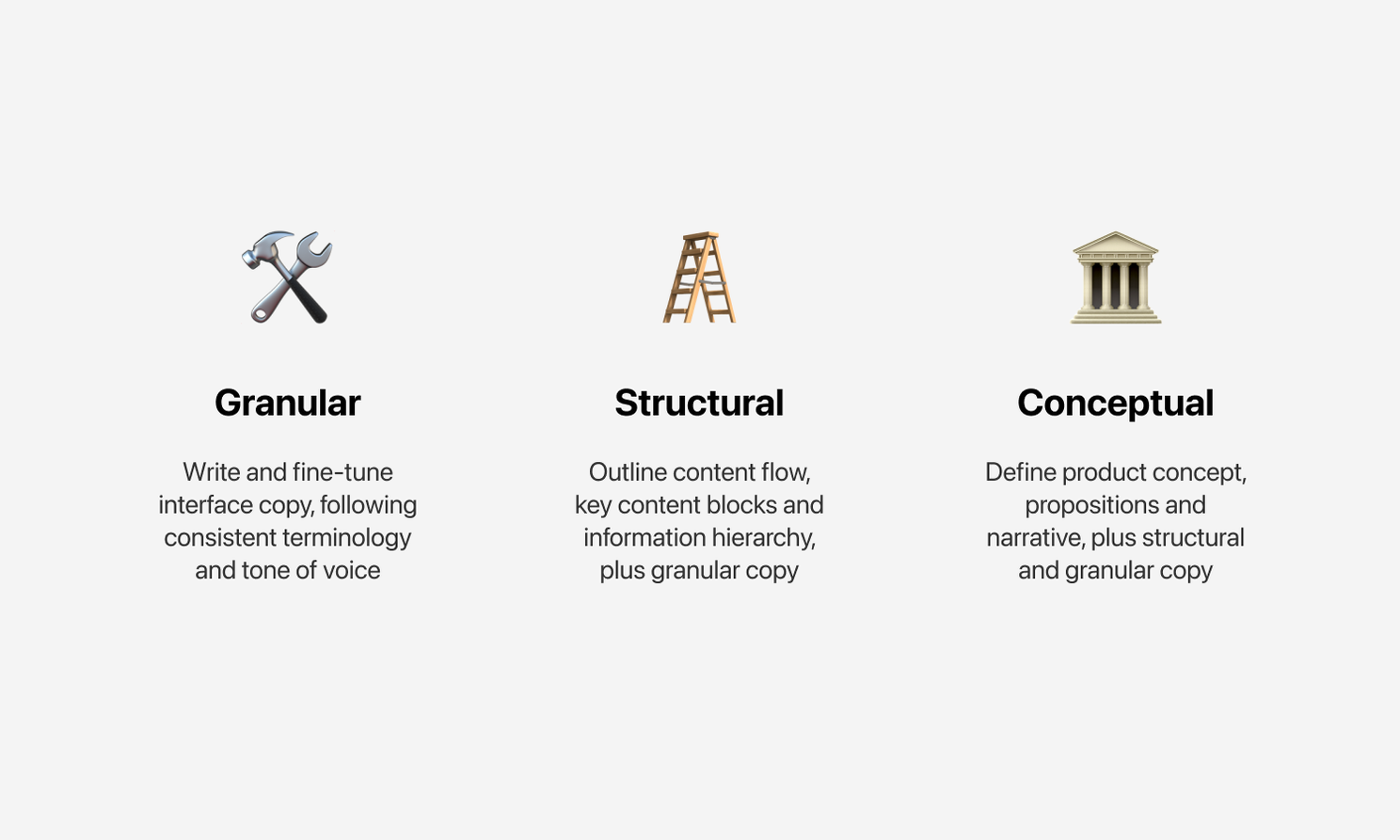
Starting last month, we’ve got a new system in place. Through observation and experience, analysis and synthesis (plus a comprehensive review of our past deliverables and backlog), I set out to classify the complexity and corresponding effort requirement of our UX writing tasks on 3 levels — which should look something like this:
How it helps
I’d really like to say that this assessment scale has since helped everyone else understand and respect our contributions as UX writers. But we’re not there yet. So humbly I’ll admit that the people it’s been helping out the most is ourselves. Having a system in place enables us to plan ahead with a clear idea of what’s to come, what’s required, what to expect, and also what to prioritize our efforts on. Having a spot in the planning room to provide our own assessment as input gives us a sense of agency to take ownership of our work, instead of letting them flood in the door, one on top of another, as we go.
And it’s not just us. It’s also the other people in the room. Designers, developers, product owners. Having the assessment scale as a discussion point is like finally sharing a common language. It allows us to explain, elaborate, elucidate, negotiate. It aligns expectations, so they know what to expect from us, just as we can learn what to expect from them. It gives everyone an idea of what kind of task requires what kind of involvement. Sometimes it’s at the end, sometimes it’s from the start. We can only hope that they’ll take this knowledge with them the next time we go into planning.
There it is, evangelization. The buzzword that everyone likes to talk of, but not many really know how to do. Evangelization, to me, starts with demystification. Before we get invited to someone’s world, we need to first invite them into ours. This is no more than an attempt to offer a glimpse into our world as UX writers — what we do and what goes into our work — because you can’t evangelize something if you can’t fully demonstrate it, and you can’t come to appreciate something until you see how it’s done.
How it evolves
You thought I was done. Well, I wasn’t. This is just the beginning. The beauty of working with the unknown is everything can be a starting point for more things to follow, more ideas to sprout, more dots to connect. We’re barely in the discovery stage. Here’s what we’ve got so far:
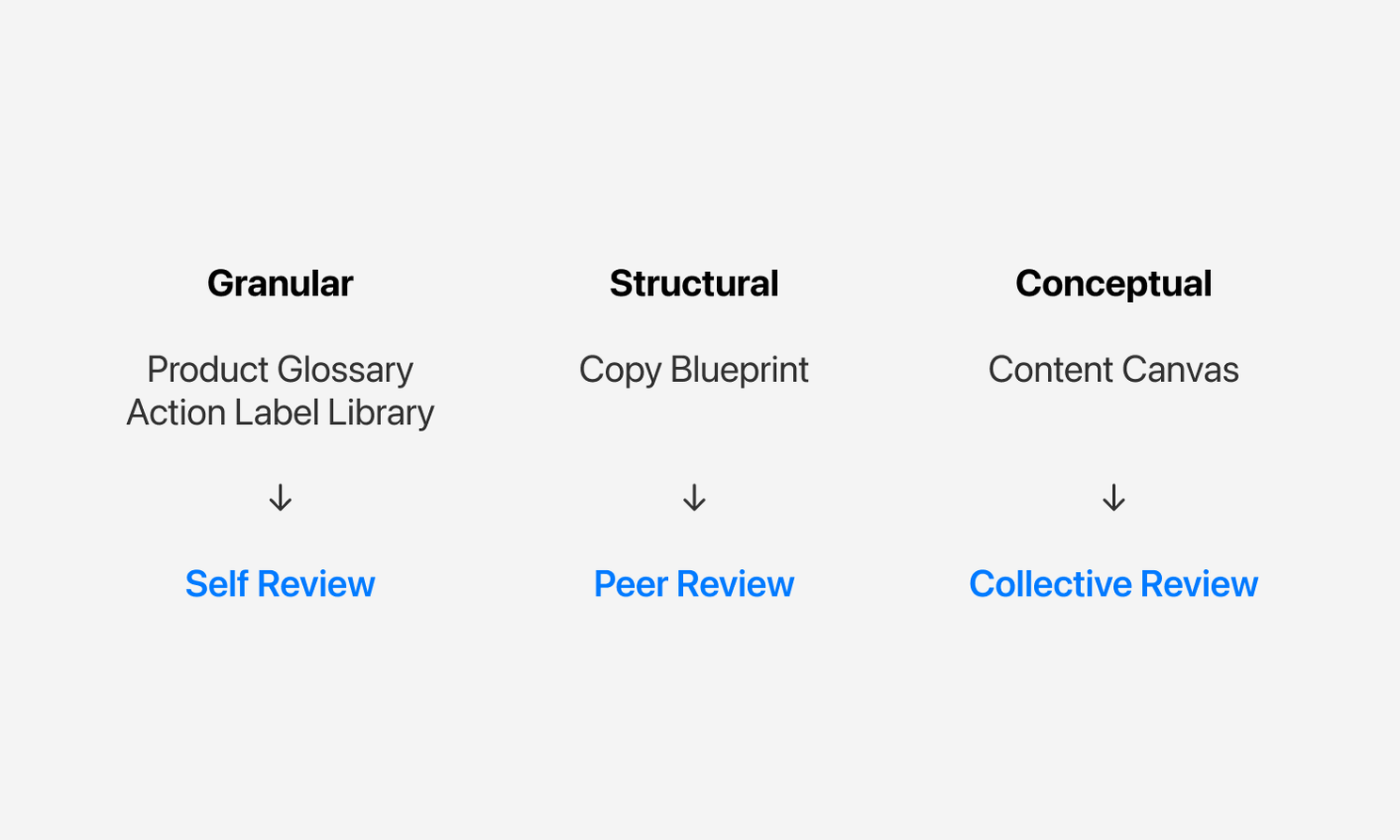
- We start the process with planning, using the assessment scale. This gets everyone on the same page with a clear idea of what needs to get done, and the degree to which it needs to get done.
- Then we do the work, using tools that our own team have developed to add to the Design Thinking toolbox. For conceptual level work, we’ve got a Content Canvas to capture a holistic overview of the product. For structural level work, we use a Copy Blueprint to map out key moments along the journey, and the information and interactions in each stage. For granular level work, we consult the Voice and Tone section of our writing guide, along with a library of product glossaries and action labels.
- Finally, review. We had been running our review cadence for a while and soon realized how much time and effort it would take to review each and every piece of copy in detail — hours that we needed to set aside at the risk of running behind on our own delivery schedule. A Review Checklist was then created for self and peer review of granular and structural items, leaving only the conceptual work to be brought to our collective forum. In the same spirit of evangelization, the checklist also comprises 2 parts: structuring content and wording copy. (See how wording comes after?)
At this point, I feel like a disclaimer is necessary. The system we’re building is nowhere near exhaustive. It should be considered and treated as a work in progress, as we’re still growing, not just in our careers as UX writers at Techcombank but in the wider context of the emerging UX writing field in Vietnam, or even the world. UX writers everywhere are still working to define their roles and responsibilities, to pave their paths in our ever-changing environment. Every day I go on LinkedIn and learn something new about my own profession. Taking Torrey Podmajersky ’s content design skill survey at the start of this year alone has been eye-opening as to how much the field can evolve, what shapes and forms it can take, and how much room I still have to grow with its evolution. This is just the beginning.
By the way, the Review Checklist is already live. Let me know if you’d like a copy.
 Zoe Tran